MODASYS: Bridging Science & Policy for Sustainable Agriculture
MODASYS (Model for Decision-Making in Agri-Environmental Systems) is a quantitative and qualitative modelling framework designed to optimise agricultural land use, including agroforestry, and management strategies for climate-resilient agri-environmental and ecosystem services.
The Hybrid next-generation digital platform provides end users with an integrated, system-based tool for alternative land use planning and equips decision-makers with the foresight required to support a sustainable agricultural future.
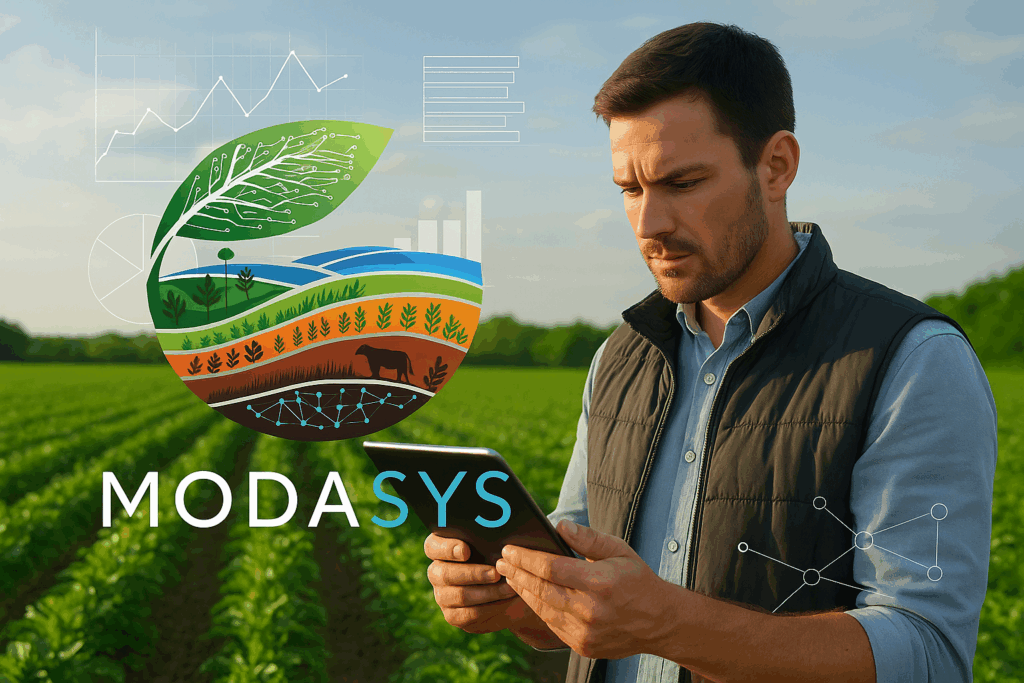

Welcome to MODASYS, a next-generation digital framework dedicated to the future of sustainable agriculture. We are revolutionising agricultural land-use planning and management to empower stakeholders for the global transition to net-zero farming by 2050. Our mission focuses on exploring alternative land uses, mitigation strategies, and cutting-edge technologies to reduce emissions, enhance carbon sequestration, and minimise environmental pollution. By building a resilient digital architecture, we provide the tools necessary for precise climate reporting and sustainable decision-making.
MODASYS has evolved through rigorous iterative stages, including a complete framework rewrite and the integration of localised algorithms, culminating in the release of HOLOS-IE v4.5. Committed to an open-source philosophy, we provide these tools to the global community to foster transparency and widespread adoption.
To accelerate our impact, we invite research institutions and industry partners to join us in joint funding initiatives and data-sharing agreements. Collaboration and access to independent datasets are vital for the continuous validation and calibration of our model, ensuring robust, science-based solutions for the global agricultural sector.
Key Features

- Alternative Farm Configuration: The model enables users to explore and simulate the environmental and economic impacts of hypothetical changes in farm management practices or land use.
- Carbon Footprinting and Reporting: It provides a transparent report of the farm’s production, greenhouse gas (GHG) emissions, carbon sequestration potential, soil health and inventory reporting.
- Farm Profitability Analysis: It estimates the economic performance of different farm scenarios, detailing costs, revenues, and overall financial viability.
- Data-Driven Decisions: It moves from assumption to actionable insights by analysing raw farm data spatially to provide site-specific recommendations.
- Climate Change Mitigation and Adaptation: It identifies and evaluates best management practices that simultaneously reduce climate impact and enhance the farm’s resilience to changing climate conditions (in progress).
- Biodiversity and Ecosystem Services: It quantifies the impact of farm management scenarios on biodiversity indicators and the resulting provision of key ecosystem services, revealing trade-offs and synergies (in progress + Future target).
- Result-based Payment: It assesses the threshold and thereby environmental outcomes required for carbon farming and result-based payment schemes (Future target).
- Environmental Sustainability: It helps to design and optimise farm practices that achieve concurrent improvements across multiple environmental indicators like water quality, biodiversity, and soil/land health.
- Policy Impact Assessment: Quantify the trade-offs and synergies of potential agricultural policies before implementation by simulating their socio-economic and environmental consequences to inform effective policy design (Future target).